

Logo UE
Copolad
Cooperation Program between
Latin America, the Caribbean and the European Union
on drug policy
No Result
View All Result
Copolad II 2015-2020
  • COPOLAD
    • What is COPOLAD?
    • Context
    • How we work
    • Objectives
    • Participants/Allies
    • Technical team
    • Public Tenders
  • Work Areas
    • National Drug Observatories
    • Demand Reduction
    • Fight against drug trafficking
    • Alternative Development
    • Control of drug precursor chemicals
    • Proportionality and criminal alternatives
    • EU-CELAC dialogue on drug policies
    • Women and Drugs
    • Policy innovation
  • Program Results
  • Knowledge Portal
    • COPOLAD III Meetings
    • Directory of centers and services
    • Library
    • Blog
    • Work groups
  • Comunication
    • News
    • Albums
    • Videos
    • Press releases
    • COPOLAD in media
  • English
    • Español
  • COPOLAD
    • What is COPOLAD?
    • Context
    • How we work
    • Objectives
    • Participants/Allies
    • Technical team
    • Public Tenders
  • Work Areas
    • National Drug Observatories
    • Demand Reduction
    • Fight against drug trafficking
    • Alternative Development
    • Control of drug precursor chemicals
    • Proportionality and criminal alternatives
    • EU-CELAC dialogue on drug policies
    • Women and Drugs
    • Policy innovation
  • Program Results
  • Knowledge Portal
    • COPOLAD III Meetings
    • Directory of centers and services
    • Library
    • Blog
    • Work groups
  • Comunication
    • News
    • Albums
    • Videos
    • Press releases
    • COPOLAD in media
  • English
    • Español
No Result
View All Result
Copolad
No Result
View All Result

Copolad > Guides > Community service and territorialization guides

Community service and territorialization guides

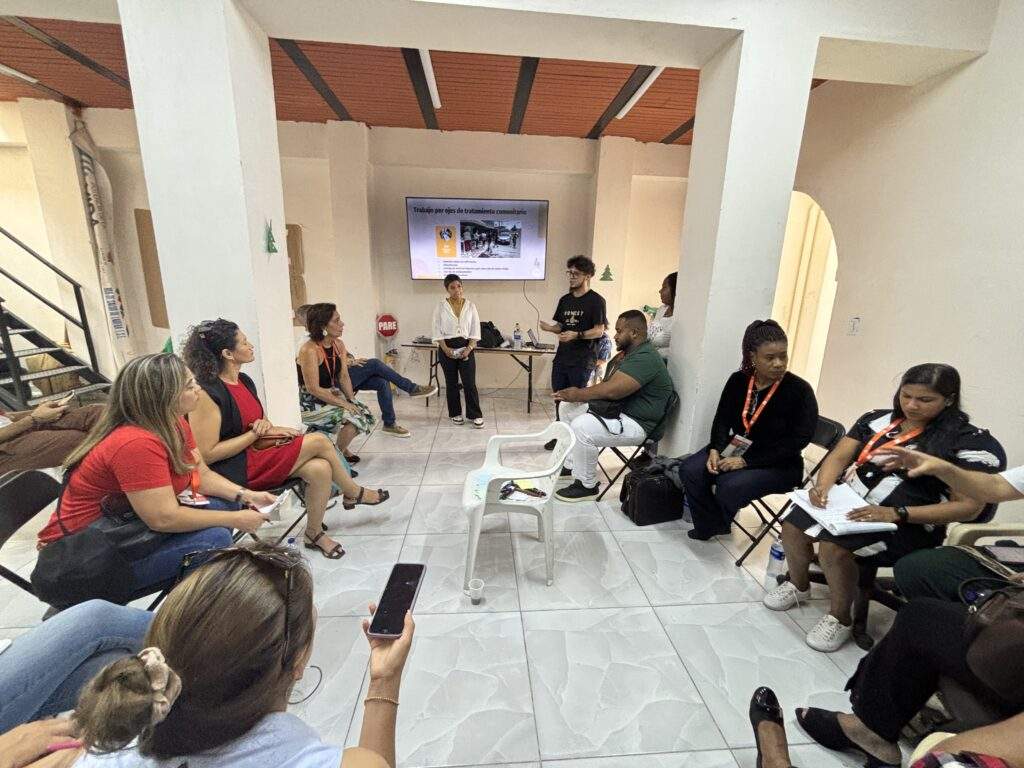
The COPOLAD III Program has promoted 14 community-based drug treatment pilot projects in highly vulnerable contexts in Latin America and the Caribbean

26/01/2026
in Guides, News
Compartir en FacebookCompartir en TwitterCompartir en Linkedin

COPOLAD III has worked with Latin American and Caribbean countries on a territorial approach to drug-related vulnerabilities using the ECO2 Community Treatment methodology, with the main aim of contributing to the improvement of policies capable of reaching highly vulnerable populations characterized by limited or no access to state care services. The main strategy is an integrated approach that considers dimensions such as occupation and work, housing, basic assistance, education, rehabilitation and harm reduction, and culture and leisure.

Territorialization is affirmed as a central strategy for building inclusive policies adapted to communities, by articulating formal and informal actors and bringing public policies closer to the territory.

Within this framework, over the last two years, countries have developed territorialization modalities that show different ways of adapting each approach to the particularities of national and community contexts.

Among the main results are:

a) The construction of a proposal for low-threshold mechanisms capable of offering accessible care adapted to the conditions of communities;

b) The design of an intervention model in highly vulnerable contexts, aimed at responding to the specific needs of groups that have not been served until now;

c) The development of harm reduction and risk management strategies, with an emphasis on populations exposed to greater social exclusion;

d) The management of resources necessary for implementation, piloting, and eventual expansion and replicability of the offer;

e) The incorporation of the experience and knowledge of community leaders as a key input for the development of contextualized proposals with the potential for expansion to different contexts.

This process also benefited from the specialized assistance of RAISSS and local technical advice, both of which accompanied the countries throughout the entire process.

COPOLAD contributes to this process because it recognizes the importance of addressing the local level, because it recognizes the value of the community in addressing consumption at this level, and because strengthening the coordination between the different levels and actors involved is essential to achieving results.

Territorialization guides

Dominican Republic 

Trinidad & Tobago

Jamaica 

Colombia 

Perú

Tags: ColombiaguiasjamaicaperúTrinidad y Tobago

Últimas noticias

Community service and territorialization guides

High-Level Seminar between EU and CELAC Drug Agencies

Legal pages

  • Legal notice

  • Privacy police

  • Cookies policy

  • Accesibility

Social media

COPOLAD is a consortium formed by:

4.-Version-negativa-color-con-tagline-1024x375
logo iila

Collaborating partners:

logo giz
No Result
View All Result
  • COPOLAD
    • What is COPOLAD?
    • Context
    • How we work
    • Objectives
    • Participants/Allies
    • Technical team
    • Public Tenders
  • Work Areas
    • National Drug Observatories
    • Demand Reduction
    • Fight against drug trafficking
    • Alternative Development
    • Control of drug precursor chemicals
    • Proportionality and criminal alternatives
    • EU-CELAC dialogue on drug policies
    • Women and Drugs
    • Policy innovation
  • Program Results
  • Knowledge Portal
    • COPOLAD III Meetings
    • Directory of centers and services
    • Library
    • Blog
    • Work groups
  • Comunication
    • News
    • Albums
    • Videos
    • Press releases
    • COPOLAD in media
  • English
    • Español
Copolad II 2015-2020

© COPOLAD. Programa de Cooperación entre América Latina, el Caribe y la Unión Europea en Políticas sobre Drogas.