



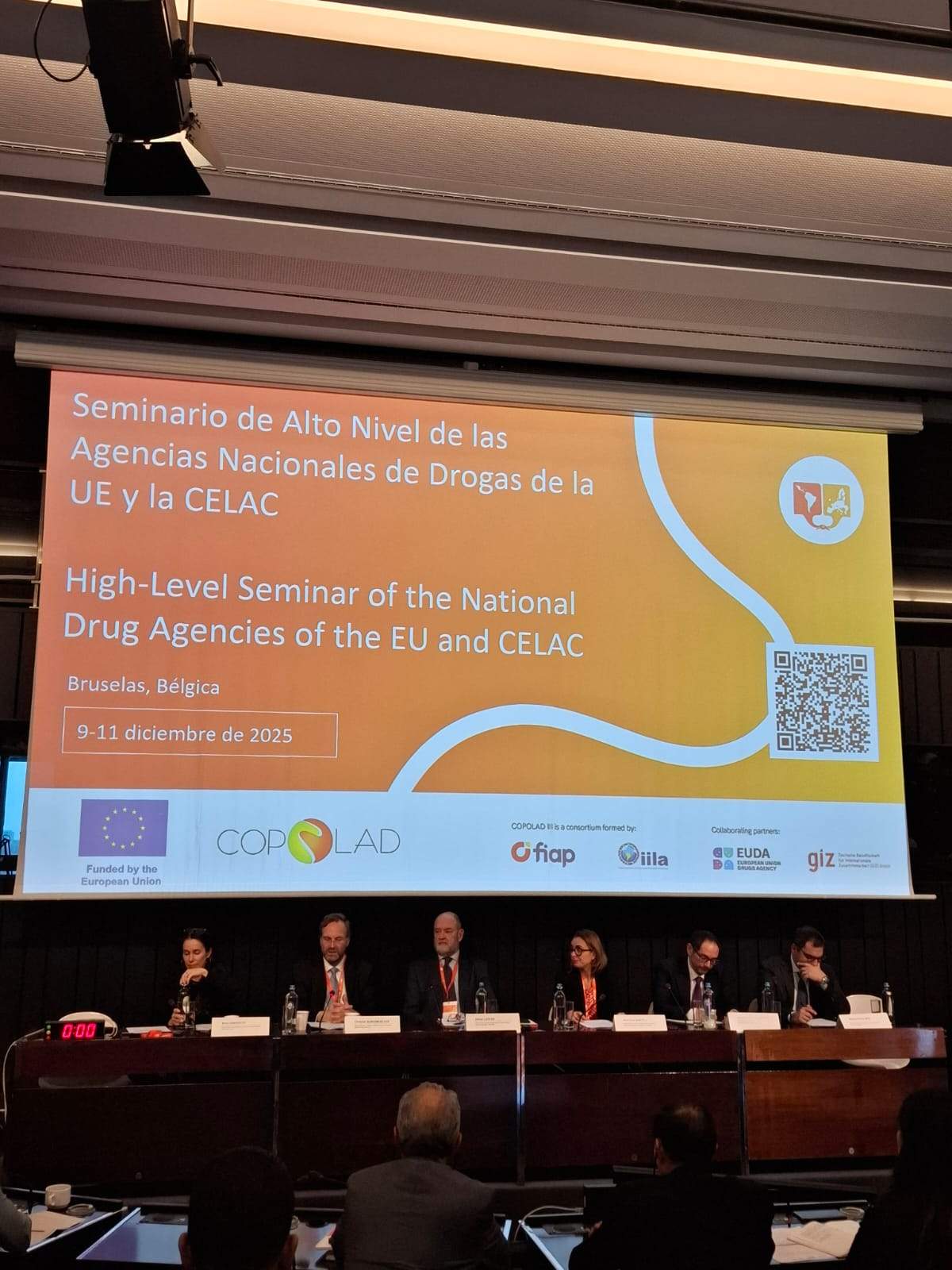
Brussels, 9–10 December 2025
Within the framework of the European Union’s COPOLAD III programme, the High-Level Seminar between EU and CELAC Drug Agencies, held in Brussels from 9 to 11 December 2025, brought together 137 senior-level representatives from both regions. Participants included 30 CELAC countries, 10 EU Member States, and 8 European institutions (DG INTPA, DG HOME, DG TAXUD, EEAS, FPI, the General Secretariat of the Council of the EU, EUDA, and the European Parliament), as well as Vice Ministers of the Interior of Ecuador and Bolivia, heads of national drug agencies, embassies of CELAC countries accredited to the EU, regional organizations (CARICOM IMPACS and CICAD/OAS), COPOLAD implementing partners and allies (FIAP, IILA, GIZ and EUDA), and representatives of the European Civil Society Forum on Drugs.
The meeting was structured around three priority pillars —drug-related violence, risk and harm reduction, and precursor control— and also included a space for strategic dialogue between EU and CELAC actors aimed at defining priorities and lines of work for the expansion of COPOLAD, in coherence with the La Paz Declaration, the Joint Declaration of the EU–CELAC Summit in Santa Marta, the Declaration for a Citizen Security Partnership, and the new EU Drugs Strategy.
This process made it possible to identify the ten key strategic points presented below.
- COPOLAD as an effective, results-oriented programme
The seminar confirmed broad consensus on the effectiveness, efficiency, and added value of COPOLAD as an instrument of bi-regional cooperation. The programme has demonstrated its capacity to support the implementation of public policies, strengthen institutional capacities, and deliver verifiable results, providing a solid basis to support its expansion. See results website: https://resultados.copolad.eu/en/home/
- Clear political mandate and focus on implementation
The expansion of COPOLAD responds to a renewed political mandate, aligned with EU–CELAC commitments and with the new EU Drugs Strategy and its Action Plan, and reinforced by the La Paz Declaration, the agreements of the EU–CELAC Summit in Santa Marta, and the Citizen Security Partnership. The need to move from dialogue to the effective implementation of evidence-based policies was emphasized, prioritizing measurable results and greater impact on public policies, particularly in view of the upcoming Multiannual Financial Framework.
- Comprehensive and people-centred approach
The added value of a comprehensive, people-centred approach was reaffirmed, balancing supply and demand reduction, security and public health issues, including justice, social inclusion, and human rights. In the programme’s expansion, this approach will guide more coherent, coordinated, and results-oriented responses, with priority attention to vulnerabilities, prevention, and the capacity of public institutions to intervene effectively and sustainably at territorial level.
- Drug-related violence as a strategic priority
The need to move beyond unfocused punitive approaches that have shown limited or counterproductive effects was highlighted, and to advance towards innovative, evidence-based interventions. Violence linked to drug trafficking and the recruitment of young people was identified as a shared threat to citizen security and social cohesion, requiring comprehensive responses that combine early prevention, focused deterrence, and improved coordination between security, justice, health, and social policies.
- Data governance and institutional preparedness
The importance of strengthening data governance was underscored, through robust observatories, system interoperability, and early warning systems, with particular emphasis on information exchange between the EU and CELAC to improve anticipation, preparedness, and decision-making.
- Risk and harm reduction as a public health pillar
Risk and harm reduction was reaffirmed as a structural pillar of drug policies, grounded in scientific evidence, public health, and human rights. Addiction was recognized as a chronic disease with associated mental health conditions and social exclusion, requiring a comprehensive, human-rights-based response (overcoming ideological barriers). The need to learn from the experience of supervised consumption rooms was highlighted, as well as to advance the institutionalization of responses, reduce stigma, and improve impact measurement by incorporating health and social outcomes.
- Precursor control in response to synthetic drugs
Comprehensive precursor control was identified as a critical priority, particularly in light of the expansion of synthetic and designer drugs, characterized by rapid adaptation and high impact. The need for updated regulatory frameworks, public–private cooperation, strengthened controls along logistics chains, and greater regulatory coherence and cooperation between both regions was emphasized.
- Differentiated approach for the Caribbean
The seminar highlighted the need for a specific approach for the Caribbean, taking into account emerging consumption patterns, the subregion’s role as a transit zone for drug and precursor trafficking, and the increase in drug-related violence, in a context of institutional constraints. The importance of strengthening observatories, early warning systems, and regulatory frameworks, as well as reinforcing subregional cooperation, was underscored.
- Coherence between EU strategy and cooperation
The EU and CELAC agreed on the need to strengthen coherence between strategies and cooperation instruments in the face of transnational threats that require shared responsibility and joint action. The role of the EU–CELAC Drugs Mechanism was highlighted, as well as the importance of moving towards the effective implementation of agreed political commitments and strategic frameworks, improving information exchange and operational cooperation, particularly against drug trafficking, arms trafficking, and other illicit flows, with the support of COPOLAD and other EU programmes.
- National ownership and cooperation with civil society
Finally, it was reaffirmed that national ownership is an essential condition for the effectiveness and sustainability of the programme. The value of intra-CELAC cooperation and the participation of civil society were highlighted as key factors to ensure impact, continuity, and legitimacy of interventions.
For further information, please see: https://copolad.eu/en/high-level-seminar-of-the-national-drug-agencies-of-the-eu-and-celac/